Showing posts with label Mini-Dredges. Show all posts

Wednesday, April 2, 2025

Way Back When Article, International Dredging Review, 2012, VMI MD-615 Dredging Soft Lime in Ohio


 VMI MD-615 DREDGING SOFT LIME IN OHIO

International Dredging Review, 2012

VMI Dredges We Make Revenue Flow Logo
Many water plants across the country are facing the problem of lime build-up from the water treatment process, with and no cost-effective way to dispose of the byproducts.

An Ohio water treatment plant came up with a creative solution to this problem that involved finding an agricultural partner to re-use the lime as a soil additive.

After researching possible partners, the plant tamed up with a local farmers' co-op and together they implemented a plan to dredge lime from the water treatment plant's quarry and sell it to area farmers at market price.

The co-op invested about $1 million in infrastructure next to the quarry, consisting of a VMI MD-615 dredge, tanks, pumps, testing equipment and a scale.  The Ohio Environmental Protection Agency approved the plan, and the co-op began serving local farmers in 2011.

The project will remove approximately 10,000 wet tons of "soft" lime from the quarry per year which the co-op then applies to farmers' fields.

Soft lime is a superior product to the dry lime that normally used to balance the pH of their fields after harvest.  The smaller particle size, or "fineness," of soft lime mixes into the soil more effectively than dry lime, and can be applied more evenly.  Because soft lime is liquid, the wind doesn't blow it away.

Environmentally, farmland application is better and more cost effective because the byproduct is not dumped into a landfill.

Wednesday, March 26, 2025

Way Back When Article, Dredging and Port Construction Magazine, July 2011, International Market Beckons

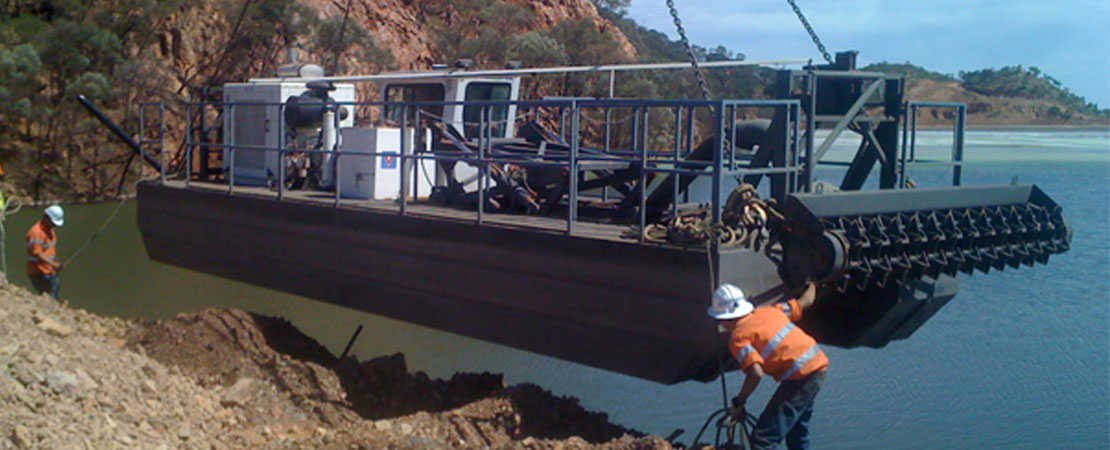
  VMI MD-815 working in Austrailia

Oklahoma-Based Dredger Manufacturer VMI Has Sold Seven Vessels To Overseas Buyers In The Past Year

Two of VMI's MD-815 dredgers were bought by Maxitool, an engineering and mining services company from Cairns, Queensland. The rugged machine features a full-width flow-through horizontal cutterhead and a recessed impeller pump for pumping - a closed vane impeller pump for pumping to higher elevations and longer distances is an option.

Maxitool uses its VMI dredgers to dewater tailing dams.  They're also used to perform maintenance work for process ponds, waterways and marine channels all around Australia.

Wednesday, March 19, 2025

Way Back When Article, Cushing Daily Citizen, December 1995 International Businessmen Visit VMI

   International Businessmen Visit VMI

VMI, Inc. of Cushing hosted a group of international businessmen who traveled from London to Stillwater in 24 hours, arriving in Cushing in time for a late lunch and tour of the VMI operation Wednesday. The group hosted by VMI owner and CEO Gene Maitlen, was here "confirming what we already knew," according to Alastair J. Morris with Balfour Engineering Consultants headquartered in Karachi, Pakistan.  (Morris is originally from London, England.)  The group has purchased three dredges for an enormous civil works project in Karachi, Pakistan.  The projected cost is $30  million and the project is funded by the Asian Development Bank and the government of Pakistan is providing local funding.  

Alauddin Babar, Chief Executive of Pak Massif International, PVT. Ltd., explained the project is one of the biggest ever in Karachi and consists of designing and constructing a water and sewage treatment plant, replacing old water mains, and involves pollution networks, all which will accomodate "roughly 150 million gallons of water a day. Before the project is completed, we will need the capacity to treat 300 million gallons a day," he said. He spoke on the population of Karachi, saying, "in 1947 there were studies on population growth and in 1952 the projection was for a population of three million people by 1980. But in 1980 there were already five million. Today, 30 million people live there."

Morris said, "this project has priority because of the condition in Pakistan." The engineer and Deputy Project Manager Imran Asif was part of the group, and his wife traveled with him. He said, "the dredges are just what we need, specifically for waste water sludge. We need a specialized form of dredging."

VMI dredges will be shipped by ocean freight in one shipment, completely assembled. Each dredge is approximately nine feet wide and 40 feet long, or as Babar said, "2.7 meters wide and 9.5 meters long. They weigh nine metric tons."

Way Back When Article, Cushing Daily Citizen, December 1995 International Businessmen Visit VMI

Robert Wagoner from the United Kingdom is the international sales consultant who connected everyone together on the purchase of the dredges. Maitlen said, "he sells all over the world. Last time I talked to him he was getting ready for a flight to South Africa."

John G. Robin, Jr. President of International Trade Consultants of Oklahoma City was instrumental in working with VMI, Inc. and the foreign parties. Syed Iftikhar Hussain of Karachi, is the Project Coordinator with China Petroleum Engineering Construction Corporation (CPECC) which is very active in Pakistan. Liu Chen Lin of Beijing, China is the contractor with CPECC working on the project.

All members of the group complimented VMI for having the equipment that would meet their specifications in the construction of Karachi project. They plan to return in about six months.

Wednesday, March 12, 2025

Way Back When Article, The Journal Record, July 1983 World Knocking at VMI Door for dredges


Bethany Firm Started by Maitlen Family with $8000 Deal

In 1972, Gene Maitlen was president of Oklahoma City Tractor Co. when a young man asked if he would assemble a dredging machine for him. Maitlen asked: "What is a dredge?" Since then, Maitlen has learned a lot about dredges. As a result, dredging equipment assembled at VMI, Inc. of Bethany is known worldwide.

VMI dredges and injection plows are used in places as far away as Tahiti, Pakistan, Colombia, California and New York, as well as nearby places like Dallas and Clinton, Okla. The dredges are used to bring solid material, such as debris, sewage or sand, up from under water by dairy farms, exclusive Tahatian resorts, a coal mine in West Virginia, the Erie Canal and a ditch in Africa.

A VMI Dredges Horizontal Dredger Working

Maitlen is president of VMI, Inc., which was started in 1977 after about $300,000 in research and development. VMI, Inc. manufactures and assembles about six dredges and sludge injection plows a year, with annual gross sales of about $1 million.

All that was started, because that young man's deal in 1972 "sounded pretty good," said Maitlen. The tractor firm was going to be paid $8,000, and the "young man" was going to sell it for $16,000 to the city of St. Louis, MO.

The oldest son, Randy Maitlen, secretary treasurer of VMI, was working in the welding shop of the tractor company at the time. A younger son, Tony Maitlen (who joined the company a year later), was still in school.

Randy Maitlen and one other tractor company employee were given the job of assembling the dredge. "It didn't work," said Randy Maitlen simply. When the machine was turned on, it went straight up in the air. The suction and balance caused the toe-end to go under water, slapping the back of the dredge straight  up. Workers were sent scrambling for safety. "They finally got the pump turned off," said Gene Maitlen. "Then they sent it back."

After 30 years in the equipment business, Gene Maitlen said he just "couldn't resist the challenge" of letting the dredge get the best of him.

"Randy liked steel and engineering," said Gene Maitlen. Both were beginning to see a market for small dredging machines that could be used by cities, governments and private industry. "We started out with about $100,000 of our money and borrowed money," said Gene Maitlen.

While developing the dredge, Randy Maitlen began working on an improved cutter-head, because competitors held the patents on those then in existence. This is the part of the machine that goes under water, churns the debris or other materials and sucks it up. (The cutter-head looks a bit like an oversized vacuum sweeper head except where the bristles would be are large shark shaped steel teeth.)

The VMI patented device churns the debris into the suction area. The mouth of the suction area ranges from 5 feet to 10 feet wide, depending on the size ordered and the type of work expected of the machine. "We get higher percentage of the solids than our competitors," said Gene Maitlen.

The company also manufactures a sludge injection plow that tills the waste into sites approved by the Environmental Protection Agency. This machine buries the waste and covers the area with soil at the same time. There is little or no odor after the process is completed, said Maitlen. The combination allows VMI to offer a complete package of dredging and disposal equipment. Before VMI, there was only one company making the injection plows, said Gene Maitlen.

When fully assembled, the VMI dredges will float in as little as two feet of water and clean an area to a depth of 15 feet. Larger VMI dredges need three feet of water and clean to a depth of 30 feet. "Our machines are in between the really big machines and the guy who stands on the shore and reaches out with a boom, said Gene Maitlen, "A ship can come right in behind one of our machines."

In 1977, the fledgling company proved its worth with its first job. Olen Chemcial Co. of Louisiana had been given a short time to clean an area by the Environmental Protection Agency (EPA). "The acid was so high the birds couldn't land," said Gene Maitlen. "EPA was going to fine them $10,000 per day if it were not neutralized by July 1." "We took lime from a pit and had it neutralized in three days."

Although the first job is one of the more memorable, Tony Maitlen prefers working for the Bali-Hai Hotels in Tahiti. The dredging equipment was purchased by the owners to restore the beach fronts of the four hotels after storms. During the hurricane season the waves wash the sand back into the ocean. "They have the only dredging machine in the South Pacific," Randy Maitlen said. The hotel owners, including three Americans and one Frenchman, now rent the dredge to other companies.

It is not only the hotel owners that are profiting from the equipment. The San Joaquin Valley of California has approximately 4,000 dairy farms in a 200 mile radius. The waste from cattle is washed into sump tanks. "After eight or ten year," said Tony Maitlen, "the sump tanks full up."

Richard Lolmaugh, owner of Agri-Till with offices in California, purchased one of the VMI dredges for $106,000. He has reported revenues from cleaning the dairy sumps and fertilizer sales of $2,500 a day. "We can't believe all the needs for these machines," said Gene Maitlen. "We've even had calls from Alaska about using them to look for gold, and yesterday there was a call from Singapore."


Wednesday, March 5, 2025

Way Back When Article, Dredging + Port Construction, November 1989 VMI Pump/Dredge/Pipe Solves Health Hazard Problems in Colombia


VMI pump/dredge/pipe solves health hazard problems in Colombia

The city municipal government (EM-Cali) of Cali, in the Central American Country of Colombia was recently faced with a serious wastewater health hazard, when two flood control lagoons within the city boundaries were filled with raw sewage as a result of flooding combined with open trench sewage canals surrounding the area.

The lagoons covered a 35 hectare area and to intensify matters, many of the poverty striken residents of the city had established make-shift dwellings on the edges of the lagoons. This situation demanded immediate attention and the city turned to the environmental engineering firm Ingesam Ltd., headed by Mauricio Guerrero, to research a solution. It was determined that the sewage could be discharged into the nearby Rio Cauca river if careful attention was paid to the discharge rate and BOD load. The next step was to devise a cost effective means of removing the sewage from the lagoons and discharging it into the river.

A VMI Dredges Horizontal Mini-Dredge working

Having read about dredging projects, Mr. Guerrero contacted Mr. Henry Boschen, export manager of VMI, Inc. of Cushing, Oklahoma, about the possibilities of using a dredger. After a trip to Colombia to view the situation it was determined that the dredging was indeed the only practical method.

The system requirements demanded using a minimum of equipment plus offering flexibility to reduce costs and to use the dredging equipment for other tasks at a later date. Saa & Angulo Construction firm of Cali was awarded the contract to dredge the lagoons. After meeting with VMI it was determined that the model MD-E615HN dredge along with a matched booster pump built by VMI would do the work.

The pipeline to be used was 8 inch polyethelene pipe, butt-fused wherever practical. The situation required the material to be dredged from the lagoons and discharged at a distance in excess of 4000m. The poly pipe was chosen for several reasons. The poly pipe offers strength but is light in weight. It can be curved to follow the contour of the ground and make turns where needed. By using a butt fusion machine the pipeline could be installed rapidly and also, when time came to remove the pipe, it could be cut in the desired lengths and reused at a new location.

The VMI MD-E615HN dredger used for the project offered numerous advantages. It is a one piece load and requires no disassembly to transport. The dredge uses a submerged pump with recessed impeller design. Composed of hi chrome material, the pump is extremely durable and its design is claimed to offer the ultimate in solids removal.

As is common in sewage, entrained gases present a problem with most pumps. This pump however has been tested and is capbale of handling in excess of 30 per cent entrained gases. It is highly effective in soilds removal and when combined with the VMI patented horizontal flow through full width suction cutter head provides excellent results in any type of sludge application.

The dredge travels by means of hydraulically driven treble sheave tracking on a small cable stretched across the lagoon as is common with most horizontal cutter dredges. All functions of the dredge are hydraulically operated being powered by a 234 horsepower diesel engine.

The dredge pump and the booster pump used were identical, as were the diesel engines, to minimise spare parts. Each pump is capable of 220' of head at 1750GPM. The discharge rate into the river was estimated to be 900 GPM so as not to exceed the allowable BOD load. Because the pumps are driven by variable speed hydraulics, the flows can be altered in virtually any flow rate within the pump curve, without reducing the engine speed below an acceptable level.

Upon completing the assembly of the dredge, booster pump and pipeline discharge package, VMI arranged shipping and the equipment was ocean freighted to Colombia. Upon arrival of the equipment in Cali, Henry Boschen of VMI arrived in Cali to assist in set up of the equipment and to train personnel.

The pipeline was the first item to be placed. To start the project to the near end of the first lagoon required the placement of over 2km of pipe. The pipeline was placed and the dredger was in position to operate after only one and a half weeks. With the system in place the first tests began. The initial test was to see if the dredger alone could flow the required amount without using the booster. The tests proved completely successful. Samples of the material were gathered and the percentage of solids obtained exceeded the highest expectations.

With the dredging project underway and going well it is estimated the project will near completion in 14 months. Although this type dredging is quite common in the many countries it was considered a first in Colombia.

Wednesday, February 19, 2025

Way Back When Article, Cushing Daily Citizen, May 1999, Dredging Operation Completed At Cushing High School Pond


Dredging Operation Completed At Cushing High School Pond

Mission Accomplished

The dredging operation at the Cushing High School Pond is complete and the "mission accomplished" said one of the individuals watching as the huge dredging equipment was loaded on a truck and taken back to the company who donated it for the project.  What was the mission?  To restore the pond to its original depth which will improve the fish habitat and clearity, and simply to beautify the body of water near the new Cushing High School field house.

The eight-week project came in under cost - way under cost. In fact it is the generosity of a local manufacturer that made the project possible at all. The dredging machine is one of several owned and manufactured by VMI.

Gene Maitlen, who founded the company here several years ago, was on hand to see the machine loaded. Seeing dredges loaded on trucks is common place for him. The company he now operates with his sons, has shipped their equipment all over the world. This one was being shipped just across Highway 33.  

Several of these smaller machines are leased by the day or month for between $1000 to $2000 per day. The Maitlens made this one available at no cost to their community. "This was the key in getting this done," said Dale Cotham who helped pull it all together. In turn, the school provided the operator and Lionel Harris of Harris Oil provided the fuel.

Jim Shields of Cushing High School, Gene Maitlen of VMI in Cushing, and dredge operator Kenneth Ward watch as a crew from Payne County load the dredge on a truck to be hauled back to VMI.  The company donated teh use of teh machine so that the lake at the high school could be leaned and more than two feet of silt removed.

Daily Citizen Photo by Don Diehl

Jim Shields of Cushing High School, Gene Maitlen of VMI in Cushing, and dredge operator Kenneth Ward watch as a crew from Payne County load the dredge on a truck to be hauled back to VMI.  The company donated the use of the machine so that the lake at the high school could be leaned and more than two feet of silt removed.

"This is one of the real benefits of living in a small town," said Cotham. "People will step up to the plate to get something done." The pond is now at its original depth of 15 foot in the deepest part and an average of seven foot, overall.

The Bank of Cushing also will help see the lake is restocked with game fish. Jim Shields said the Cushing Vo-Ag class plans to make restocking a project. "None of this could have happened without the help of others."

Operator Kenneth Ward waved goodbye to the machine. The dredging, which made statewide news when he turned up a purse that had been missing for 30 years, had been an adventure for him. He also found old tires, hubcaps, fishing poles and lures and even a Texas license plate. "I also found some grass carp teeth," Ward said. "At least that's what people tell me they are," he said. "Pretty weird." Some of the carp along with game fish were victims of last summer's drought.

An agreement made with the City of Cushing years ago when the city gave McLaury's Pond and surrounding property to the school calls for the school to maintain the body of water for use of the public. Ward was trained to operate the dredge by Randy Maitlen. The job took about eight weeks.

https://vmidredges.com/dredginglake.html

Wednesday, February 12, 2025

Way Back When Article, International Dredging Review, April 1990, Oklahoma Dredge Manufacturer Builds Quality Machines For Sludge, Sand and Gravel


Gene Maitlen considers VMI's cutterhead the most successful part of the company's dredge design. The cutterhead is so effective because it is a direct feed to the pump, says Maitlen, company president. As the cutter revolves, the pump sucks a full width draw into the recessed-impeller pump, without having to auger the material to the center. The cutter is reversible, so the dredge can move backward and dig with the same efficiency as when moving forward.

VMI Dredges We Make Revenue Flow Logo

The company fabricates the patented horizontal cutterheads, including the teeth, along with portable dredges from four through 12 inches.

VMI (Vaughn-Maitlen Industries) operates from a new manufacturing complex in Cushing, OKlahoma, 65 miles northeast of Oklahoma City. In business since 1972, VMI's major customers have been sludge and industrial pond operators. When they moved into their new facility last year, they increased both capacity and capability, and are now turning out regular cutterhead dredges in pump sizes up to 12 inches, where previously their largest dredge was 10 inches. They have already sold one of these larger dredges to a sand and gravel producer in Wichita, Kansas, and have just completed another.

Nearing completion, this dredge will cut and slurry heavy materials with its patented horizontal cutterhead, which feeds directly into a full-width suction.

Nearing completion, this dredge will cut and slurry heavy materials with its patented horizontal cutterhead, which feeds directly into a full-width suction.

Maitlen's business partner is Bob Vaughn, with whom he spent a career selling construction equipment. Seeing a need for a portable dredge for sludge management, they started their dredge manufacturing company, producing a heavy, durable pontoon-mounted dredge that had immediate success in the industry.

Gene Maitlen has returned to Cushing, the home of his pioneer forebears, and lives on the ranch where he grew up. He enjoys the dredge business and works with wife Peggy and sons Tony and Randy. They made the move from Bethany, Oklahoma - a suburb of Oklahoma City - in March 1989, seeking a rural lifestyle as well as expanded manufacturing facilities.

Peggy is the secretary/treasurer of the company, and greets visitors from her desk in the main lobby. Randy, who started with the company at its outset, designs the dredges and modifications and is working on a totally computer-operated dredge. Tony joined the company in 1976 as sales manager. Of a more cosmopolitan bend, Tony enjoys traveling for the business for sales and customer support. International Sales Manager Henry Boschen calls on customers in the northeast United States as well as in other countries.

Maitlen designed the building with input from Peggy and his sons, and contracted the construction locally. The shop/office is a two-story corrugated steel building painted the company's signatory sky blue, with comfortable offices in front and the shop running the length of the building in back. An overhead crane serves the entire shop, where three or four dredges can be in progress at the same time. Fabrication facilities for the cutters and teeth are conveniently placed and one wall is dedicated to storage of spare parts.

Behind the shop a second building - a paint room equipped with infrared heat lamps - holds a dredge newly painted sky blue. This is a 12 inch standard cutterhead dredge - one of the first non-horizontal cutters they have made. VMI dredges are coated with coal tar epoxy below the waterline after being sandblasted to bare metal. Anodes are added when a dredge is bound for seawater, to resist corrosion.

Gene Maitlen with a dredge in progress in VMI's year old plant.

Gene Maitlen with a dredge in progress in VMI's year old plant.

Over the years they have modified the dredge design to add certain improvements. A rubber shock absorber on the cutter motor takes the impact and prevents the drive shaft from breaking if the cutter hits a rock or other hard objects. All the systems are hydraulic, operated with each circuit having its own individual pump. This gives it the capability of all systems operating simultaneously without any loss of power. Using Cummins and Cat engines for power, VMI puts a 234 horsepower engine on a six inch dredge, correspondingly larger engines on larger pumps. This is more power than other manufacturers use, says Maitlen, but it insures that all the systems have adequate power at all times.

Gene Maitlen, right, describes teh patented hydraulic lift connector on teh sludge injection plow the company manufactures.  His visitor is Mike Cykoski.

Gene Maitlen, right, describes the patented hydraulic lift connector on the sludge injection plow the company manufactures.  His visitor is Mike Cykoski.

The cutter suction dredges operate from swing cables and spuds, while the horizontal cutter dredges move on a single line traverse anchored on shore. All functions are variable speed and not operated from gearboxes. Combined with adequate horsepower to drive the system, VMI's machines maintain sufficient head to move material as far as necessary in any project. Relief valves are built into the hydraulic pumps and motors.

The dredge pontoons are filled with foam to prevent the dredge from sinking. This is important in remote areas, where armed passersby may take pot shots at a dredge, says Maitlen. Even if someone drilled a line of holes with a machine gun, a foam-filled dredge would only float lower in the water, he said.

Since the move to Cushing, part of the identity of the company is taken from the town and surrounding territory, the traditional land of the Sac and Fox Indian nation. One of VMI's welders, Josh Williamson, is a full blooded Sac and Fox who does competition Native American dancing throughout the country in his spare time. Dressed in full regalia, he entertained at VMI's opening ceremonies last March when the facility opened, along with several other local dancers. Prisci Dean, another VMI employee, is also part Sac and Fox.

"I suppose your first question is why anyone is building dredges in the middle of Oklahoma," said Maitlen to a visitor. Besides giving the family a rural lifestyle in their ancestral home, Cushing offers a good opportunity for business. The local Chamber of Commerce offers land at no cost to new industry moving in, and donated six acres worth $3000 an acre to VMI in a business park east of town. VMI provides 15 jobs, an annual payroll exceeding $200,000 and county taxes.

Dependent on the oil industry, Cushing has seen a decline in recent years and has a workforce eager for employment, according to Tony Kaai, President of the Chamber of Commerce. A rural community of about 8000, Cushing is an old-fashioned prairie town, with clean wide streets lined with hundred-year-old houses. VMI's presence in the community has added jobs and income, and the Maitlens' valuable participation in the community. They give dredging a good name on the great plains.

https://vmidredges.com/qualitymachines.html

Monday, February 10, 2025

Guy Says . . . Roses are red, violets are blue, if dredging were easy, everyone would do it too.

🌹⚙️ "Roses are red, violets are blue, if dredging were easy, everyone would do it too." 💪💘

 This Valentine’s Day, let’s give some love to the hard work that keeps our waterways clear, our lakes deep, and our ecosystems thriving. 💧 Because nothing says "I dig you" like a perfectly executed dredge job!

 Tag someone who deserves a shoutout for getting the tough jobs done or someone who just really loves mud. 😂👇

 #DredgingWithHeart #ValentinesDay #GuyTheDredgeGuy #VMIDredges #thisishowyoudredge

Guy the Dredge Guy Says . . .

 https://youtube.com/shorts/i2cLnYedyNo?feature=share

Friday, February 7, 2025

The Evolution of Horizontal Mini-Dredges: A Legacy of Innovation in Dredge Manufacturing


                 The Evolution of Horizontal Mini-Dredges: 

A Legacy of Innovation in Dredge Manufacturing


Horizontal mini-dredges have come a long way since their inception, and VMI Dredges has been at the forefront of that evolution. As a pioneer in dredge manufacturing, we’ve spent decades refining and perfecting horizontal dredges to meet the needs of a growing and dynamic industry. This evolution reflects not only advancements in technology but also our commitment to innovation, quality, and the success of our clients.

The Early Days of Horizontal Dredging

In the early days of dredging, equipment was often bulky, difficult to operate, and limited in its capabilities. Vertical cutter dredges dominated the industry, but they weren’t always the best solution for every job. For smaller waterways, industrial lagoons, and shallow sediment removal, something more versatile and precise was needed.

Horizontal mini-dredges emerged as the answer. Compact, efficient, and easier to maneuver, they quickly became the go-to solution for smaller-scale projects. VMI recognized their potential early on and began designing horizontal dredges tailored to meet these specific needs.

VMI’s Role in Horizontal Dredge Development

At VMI Dredges, we’ve been instrumental in shaping the horizontal dredge market. From the beginning, our focus has been on creating machines that combine power, precision, and reliability. We listened to our clients and understood the unique challenges they faced—limited access to job sites, varying sediment types, and environmental concerns.

Our engineers got to work, designing horizontal dredges that addressed these pain points. The result was a line of equipment that could deliver exceptional performance in a compact, user-friendly package.

Key Innovations Over the Years

The evolution of horizontal dredges is marked by key innovations, many of which were driven by client feedback and real-world demands. Here are a few milestones in VMI’s journey:

Hydraulic Power Systems: Early horizontal dredges were powered by mechanical systems, which could be unreliable and difficult to maintain. VMI introduced hydraulic power systems, providing more consistent performance and easier operation.

Precision Controls: As projects required more accuracy, we developed advanced joystick controls and hydraulic systems that allowed operators to maneuver dredges with pinpoint precision.

Customization Options: No two dredging projects are the same, and VMI responded by offering a range of customization options. From adjustable digging depths to specialized cutter heads, our horizontal dredges could be tailored to meet specific needs.

Environmental Considerations: As environmental concerns grew, VMI took steps to ensure our dredges were as eco-friendly as possible. Fuel-efficient engines, low-impact designs, and advanced sediment management systems became standard features.

Remote Operation Capabilities: In recent years, we’ve integrated remote operation technology into our horizontal dredges, allowing operators to control the equipment from a safe distance. This has improved safety and efficiency on job sites.

Meeting Industry Challenges

The dredging industry is constantly changing, and horizontal dredges have had to adapt. Increasing regulations, tighter budgets, and more complex projects have pushed manufacturers to innovate. VMI has met these challenges head-on, ensuring our equipment stays ahead of the curve.

Our horizontal dredges are now used in a variety of industries, from wastewater treatment and mining to environmental remediation and marina maintenance. They’ve proven their value time and time again, helping clients complete projects on time and within budget.

The Future of Horizontal Dredges

As we look to the future, the evolution of horizontal dredges is far from over. VMI is committed to continuing its legacy of innovation, exploring new technologies like automation, real-time monitoring, and sustainable energy sources.

We believe that horizontal dredges will play an even greater role in the industry, especially as projects become more environmentally sensitive and technically demanding. Our goal is to ensure that VMI dredges remain the gold standard, delivering unmatched performance and reliability for years to come.

Why VMI Dredges?

The evolution of horizontal dredges is a story of progress, innovation, and a relentless drive to improve. At VMI Dredges, we’re proud to have been a part of that story from the beginning. Our equipment isn’t just built to perform—it’s built to last, with decades of expertise behind every weld, bolt, and hydraulic system.

When you choose VMI, you’re not just getting a dredge. You’re getting a partner with a proven history of success and a commitment to helping you achieve your goals.

Experience the difference of a VMI horizontal dredge. Let us help you tackle your next project with equipment that’s designed to evolve with the industry and exceed your expectations.

VMI Dredges Logo

Darren Waldeck, Director of Business Development, 918-399-6013

Pat Sumpter, Sales Manager, 918-225-7000, Ext. 12

www.vmidredges.com • sales@vmidredges.com

Call Now       Email Us


#VMIDredges #HorizontalDredges #InnovationInDredging #DredgingEvolution #BuiltToLast #FutureOfDredging

Thursday, February 6, 2025

Throwback Thursday Alert! Check out this vintage beauty—one of VMI's iconic dredges that helped set the standard in the dredging industry!

  ðŸš¨ Throwback Thursday Alert! 🚨

Check out this vintage beauty—one of VMI's iconic dredges that helped set the standard in the dredging industry! 🌊⚙️ Back when innovation met reliability, this machine rolled out to tackle lagoons, marinas, and ponds like a pro.

VMI Dredge Throw Back Thursday Pic
From cleaning waterways to restoring ecosystems, this dredge was designed for precision and efficiency, making waves (literally) in its day. 🚤✨

💡 Did You Know? VMI has been engineering dredging solutions since 1972, transforming projects worldwide!

What’s your favorite memory or project involving a VMI dredge? Share it below and let’s celebrate the history that drives our future. 🛠️👇

#ThrowbackThursday #VMIHistory #DredgingLegends #WaterwayManagement #InnovationThroughTheYears #VMIDredges

Wednesday, February 5, 2025

Way Back When, Sunday, January 23, 1994, Cushing Daily Citizen: Everything Looks Real Good At VMI Operation

 Everything Looks Real Good At VMI Operation

By Terry Hoggatt, Managing Editor
Cushing Daily Citizen
Sunday, January 23, 1994

Gene Maitlen, who heads the operation of VMI here, says in a few months he's going to "walk up to Bill Cubbage and say, "I've fulfilled my contract."

When VMI worked with the Cushing Chamber of Commerce and other entities here prior to making the decision to locate in Cushing, one of the stipulations in the "package" Maitlen agreed to is that the industry would stay a minimum of five years.

"We're getting close to that fifth year," Maitlen said.  "One of the persons we were working with was Bill Cubbage.  I'm going to tell him to give me a piece of paper that says 'Paid in Full.'  I think that stipulation is a good idea, by the way.  I think it's a good idea to make sure you get something back."

The company's best year was 1990.  "Then the economy turned sour," Maitlen said.  He added, "Now things are turning around.  I'm sure this year will be our best ever.  In fact, I'm sure of it.  Everything looks real good."

VMI primarily manufactures environmental-related equipment.  Dredges are turned out in the factory in the northeast industrial park (near the Fleetwood building).  The company also utilizes a "Sludgifier" that is gaining plenty of customers.  the equipment is particularly effective for heavily-polluted streams, even if hazardous material is involved.

"What you do," Maitlen says, "is put the apparatus on an excavator boom and mount an engine to power it.  You can reach into the area and literally encase the waste.  By the time you get clear around it, it sets up like concrete.

"After you enclose the area, you can plant flowers on it."

The Cushing facility, Maitlen says, is "busy all year"  We've held our own and now we're looking at hiring more personnel."  VMI employs 12 persons at this time, but Maitlen said, "Last year we were building for stock.  Now we're getting orders for more projects."

A VMI MINI-DREDGE on the grounds outside the massive building in Cushing's northeast industrial park on Maitlen Drive

A VMI MINI-DREDGE on the grounds outside the massive building in Cushing's northeast industrial park on Maitlen Drive

Annual payroll at VMI, including commissions, is approximately $200,000.  All of VMI's products are constructed here ("unless," Maitlen said, "we use an existing piece of equipment and customize it to a certain need") in the machine shop in the huge building.  A parts department allows VMI to ship parts overnight to customers anywhere in the U.S.  "It takes a little linger to get parts to a foreign country," Maitlen said.

Some of the requests for VMI machinery are from far away places such as Manila, Thailand ("We had to build a special machine for that," Maitlen said) and Saudi Arabia.  "We've also done business in Indonesia," said Maitlen. "The Pacific Rim is getting serious about cleaning up the environment.  We've also dealt with places in South America."

The Manila request involves a river that, a letter from officials there says, "is nearly dewatered."

"The river is full of sand, mud, pebbles and garbage, " Maitlen siad.  "We've been sending information back and forth.  It will probably be quite a project."

One piece of equipment that was manufactured at the VMI facility is headed to a Chicago contractor.  Maitlen said the firm is the largest of its kind in the world.  "We furnish nearly all their dredging equipment," he said.  "They buy and lease from us.  We have another order that's headed for a big job in Mississippi."

When VMI ships a piece of equipment, a technician goes along to train customers how to operate and maintain the machinery.  That technician is sometimes a special person.

"When we go anywhere in the free world, we send on tehnician," Maitlen said.  "When we go somewhere someone is apt to shoot you, we send another guy.  He's a former Green Beret and he handles those countries.  Sometimes he's gotten off an airplane and seen guns pointed at him.  He likes that."

Maitlen is proud of all his employees and he has a favorite statement:  "When someone wants something, we will build it.  We've go the best personnel, bar none, right here in Cushing."

One customer needed a special, two person cab on a certain piece of equipment.  "Steve Cantrall (a VMI employee) studied the request, made a design, and we built it," said Maitlen.

A VMI customer wanted a special two person cab for a piece of equipment.  Steve Cantrell "studied the request, designed it and we built it," said VMI head man Gene Maitlen, who proudly adds, "If someone wants something, we will build it."

A VMI customer wanted a special two person cab for a piece of equipment.  Steve Cantrell "studied the request, designed it and we built it," said VMI head man Gene Maitlen, who proudly adds, "If someone wants something, we will build it."


VMI is home to the "nation's largest and oldest mini-dredge company.  It's still owned by its original owners," the personable Maitlen says with pride.

The building is also "home" to the largest rental-fleet of dredges in the United States.  Mini-Dredge Leasing, Inc. is owned and operated by Gene's sons, Randy and Tony.

"We have a lot of customers who have a short term need for our equipment," Maitlen said.  "Maybe just 60 days or so.  So, Randy and Tondy formed Mini-Dredge Leasing and their business is doing well.  They have their offices right here in the building." He smiled and added, "We sell dredges to them.  They're good customers."

"And," Maitlen continued, "Randy and Tony are good workers.  They get just as dirty and greasy as anyone."

Maitlen, who advertises his company in a world-wide publication and other trade magazines ("we've got letters and faxes from all over the world," he said), started in the equipment business in Cushing in 1949 in building located on East Main (current location Williams Monument).  "I've got over 34 years experience in that type of work," he said.

Gene Maitlen, head of the VMI world-wide operation

Gene Maitlen, head of the VMI world-wide operation

He left Cushing and for a time was in a location near Oklahoma City.

Why choose Cushing?

"Because of the Cushing Chamber of Commerce and Industry," he said.

"Where I come from, the chamber there didn't even know we existed.  They never visited.  There was a vo-tech school nearby and it wasn't even interested in us.

"The Cushing Chamber bent over backwards to help us and to welcome us.  Central Vo-Tech (in Drumright) has been very helpful.  Our chamber continues to keep in touch with us.

"And, of course, I always wanted to come back to Cushing and live at the old home place (Northeast of Cushing).  Randy married a Cushing girl and everything pointed to Cushing.

"My wife and I live on the home place now and we're very happy.  It was the wisest decision I've very made."

VMI at this time has "plenty" of room to fulfill current orders.  But, Maitlen Said, "We built this facility so we can expand.  We could easily wind up triple the size we are now.  And I think we will in the future.

A dredge begins taking shape inside the VMI machine shop.  The building also houses offices, a break room, conference room, and a parts department that allows the company to shop parts anywhere in the world.

A dredge begins taking shape inside the VMI machine shop.  The building also houses offices, a break room, conference room, and a parts department that allows the company to shop parts anywhere in the world.

"I have very high hopes."

Industry Spotlight is a monthly venture involving the Daily Citizen and the Cushing Chamber of Commerce Existing Industries Committee.
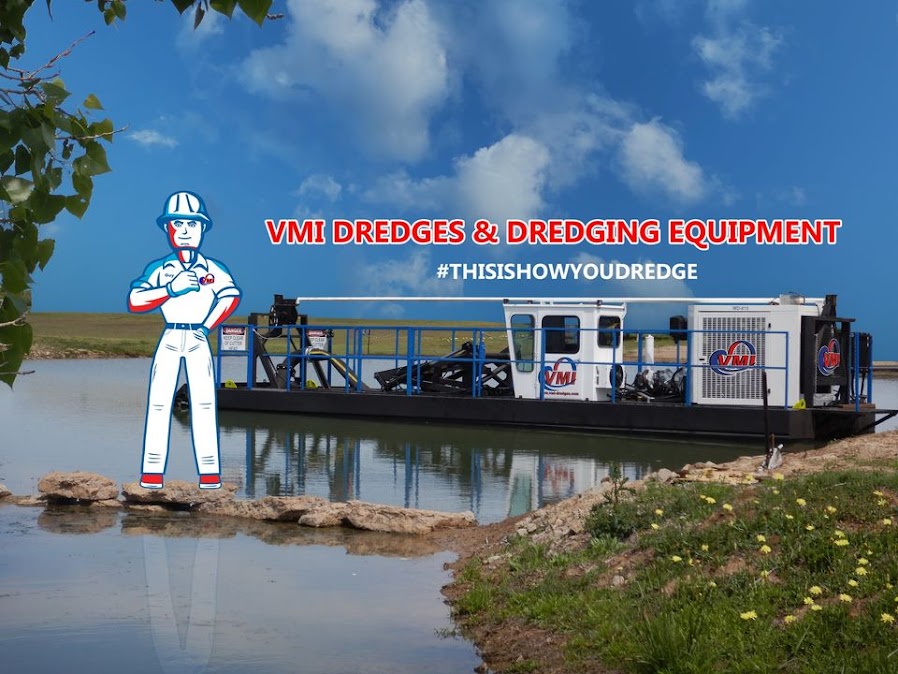
Another VMI MD-615 is loaded, secured and headed east-ready to get to work in Virginia.

  https://youtube.com/shorts/obt3tPkOHVQ?feature=share Virginia bound! 🎶 Another VMI MD-615 is loaded, secured and headed east-ready to g...